
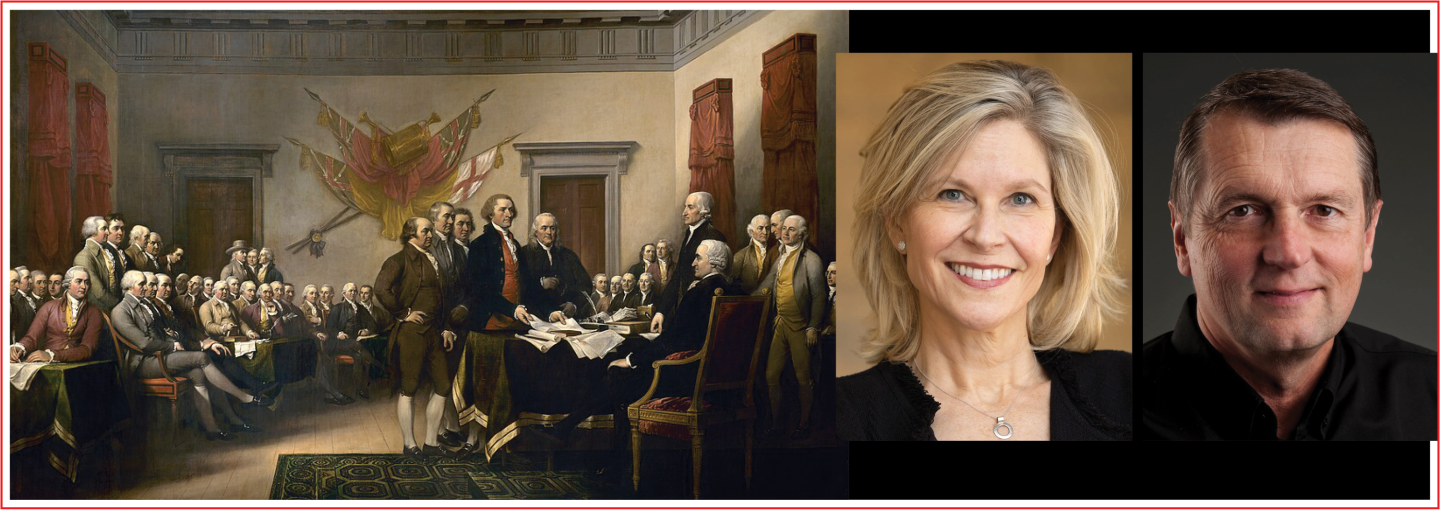
Humanities West presents the 250th Anniversary of the Declaration of Independence
Not yet a member? Members receive discounts on tickets, free events, special programs, early notice, travel opportunities and more. Plus, your membership helps support our work as a nonprofit. You can become a monthly sustaining member for just $13 a month.
It has been 250 years since upstart young leaders of the American colonies declared independence from King George III and imagined founding a republic, based on a democracy of sorts, which has, over 25 decades of difficult growth and adjustment, arrived at our current version of a government “of the people, by the people, for the people,” as President Lincoln put it.
How far has our democracy come in a quarter of a millennium? And do we even believe yet in the idea at its core: that our civilization should change as the majority sees fit, with constitutional guardrails to protect us from their worst follies? Or are we almost all born authoritarians, bristling whenever the majority disagrees with our own visions of what America should be?
Caroline Winterer will explain why the appeal to classical antiquity was so central to the American Revolution, and how even today it continues to shape our sense of America’s destiny. The United States is covered with classical architecture, and has a Senate, named for the ancient Roman senate. Even 250 years after the American Revolution, we continue to ask, “Are we Rome?” Is the American experiment in government by “we the people” doomed to fail, just as Rome did long ago? How can the United States avoid Rome’s destiny? Is the appeal to Ancient Rome an opportunity—or a trap?
Ed Larson will explain why, in response to the words and deeds in the American fight for liberty, 1776 marked such a dramatic and decisive shift in patriot thinking. In a matter of months, the great bulk of American patriots went from seeking their rights as British subjects under royal rule to demanding their liberty under representative governments of their own making. With this came the corollary and similarly revolutionary embrace of the principle of the rule of law and the ideal of human political equality.
Join us to celebrate the improbable American experiment that has partially succeeded in achieving its goals for so long.
This program has 2 types of tickets available: In-person and online-only. Please pre-register to receive a link to the live-stream event.
If you have symptoms of illness (coughing, fever, etc.), we ask that you either stay home or wear a mask. Our front desk has complimentary masks for members and guests who would like one.
The Commonwealth Club of California is a nonprofit public forum; we welcome donations made during registration to support the production of our programming.
A Humanities Member-led Forum program. Forums at the Club are organized and run by volunteer programmers who are members of The Commonwealth Club, and they cover a diverse range of topics. Learn more about our Forums.
In association with Humanities West.
Winterer photo by LiPo Ching Stanford University; Larson photo by Cronhall Photography; photos courtesy the speakers; painting: John Trumbull's Declaration of Independence.
Commonwealth Club World Affairs is a public forum. Any views expressed in our programs are those of the speakers and not of Commonwealth Club World Affairs.
All ticket sales are final and nonrefundable.
The Commonwealth Club of California
Taube Family Auditorium
110 The Embarcadero
San Francisco, CA 94105
United States
Edward Larson
University Professor of History, and Darling Chair in Law, Pepperdine University; 1998 Pulitzer Prize in History for Summer for the Gods: The Scopes Trial and America’s Continuing Debate over Science and Religion; Author, Declaring Independence: Why 1776 Matters
Caroline Winterer
Chair, Department of History, and William Robertson Coe Professor of History and American Studies, Stanford University; Author, American Enlightenments: Pursuing Happiness in the Age of Reason and How the New World Became Old: The Deep Time Revolution in America
Moderator: George Hammond
Author, Conversations With Socrates
4:15 p.m. doors open, check-in & reception
5–7:30 p.m. program
(all times Pacific)
COST
In-person:
$25 members
$35 nonmembers
Free for Leadership Circle members and students (with valid I.D.)
Online:
$10 members
$20 nonmembers
Free for Leadership Circle members and students (with valid I.D.)
